

Guest Bloggers
-

Louisa Benton
Executive Director
-

Steven P. Roose, M.D
Professor of Clinical Psychiatry
-

Huda Akil, Ph.D
DTF Chair
September 10 – World Suicide Prevention Day,
September 10, 2019

Today, September 10, is the annual World Suicide Prevention Day, and we here at HDRF wanted to take a moment to discuss the day itself as well as ways all of us can help to prevent suicide in our own communities.
Click here to read the full article…
HDRF Scientist Finalist for 2019 Blavatnik Award for Young Scientists,
September 5, 2019

We are proud to announce that Dr. Carla Nasca, a postdoctoral fellow with our Depression Task Force, is a finalist for the 2019 Blavatnik Award for Young Scientists.
Her work, funded in part by HDRF, has discovered that a natural chemical in the body (acetyl-L-carnitine, or LAC for short) can rewire the brain and is a possible new treatment for depression.
Click here to read the full article…
Southampton Race of HOPE Breaks All Records,
August 8, 2019

Thank you to the hundreds of participants who came out for the Race of Hope to Defeat Depression! This year’s event was a huge success! More than 700 men, women, and children gathered on a sunny Sunday morning in Southampton to take part in the fourth annual Race on August 4.
Click here to read the full article…
Pride Month and Mental Health Awareness,
June 28, 2019

Today, June 28, marks the 50th anniversary of the Stonewall Riots, the event that sparked the LGBTQ+ rights movement in the United States, and later inspired Pride events every June.
In honor of this milestone, we want to shed light on mental health issues affecting LGBTQ people.
Click here to read the full article…
Wrapping Up Mental Health Awareness Month,
June 7, 2019
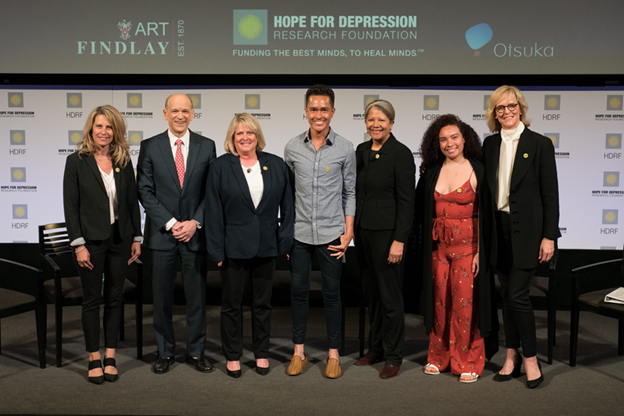
Hope for Depression Research Foundation, hosted its Second Annual ‘Next Generation Mental Health’ Panel Discussion on Wednesday, May 29, 2019, at the Paley Center for Media.
Moderated by HDRF Executive Director Louisa Benton, the panel was held during Mental Health Month and focused on the topic “Bullying and Mental Health.”
Click here to read the full article…